REVIEW · CHIANG MAI
Chiang Mai-Chiang Rai: White Temple-Blue Temple-Lalita Cafe
Book on Viator →Operated by Thailandlocaltour.com · Bookable on Viator
White, blue, and black temples in one long day. I like that this trip uses an English-speaking guide and keeps things efficient with an air-conditioned vehicle. I also like that lunch and key entry tickets come included, so you can focus on photos and details instead of budgeting mid-day. One thing to consider: guide quality can vary, and if your English is limited, explanations might not always be as detailed as you’d want.
You leave Chiang Mai early (7:00am) and you’re back at the same meeting point, with an 11-hour day. The route is built around three signature Chiang Rai temples, plus a short hot-spring stop and time driving around the city. If you want a relaxed pace, this is still a long day, but the small group size helps.
The vibe here is hands-on and visual. You’re not just ticking boxes; you’re seeing three very different ways artists use Buddhism, design, and symbolism to make modern statements—especially at the White Temple and the Blue Temple.
In This Review
- Key things I’d focus on before you go
- Price and Logistics: What $53.98 really buys you
- Chiang Rai in a Day: The best way to see three temple styles
- Wat Rong Khun: The White Temple’s mirror-glass symbolism
- Baan Dam Museum (Black House): Surreal northern Thai design
- Wat Rong Seur Ten (Blue Temple): Still under construction, full of color
- Mae Khachan Hot Spring: A short free break
- Chiang Rai Drive Time: Why some of the day is just getting around
- Optional Add-On Stops: Lalita Café and the Karen Long Neck village
- Lalita Café program (if selected)
- Longneck Karen Village (if selected)
- Comfort and attention: Small-group effects that matter
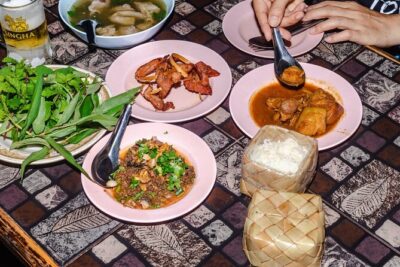
- What to expect at lunch and entry tickets
- Should you book? A quick fit check
- FAQ
- How long is the Chiang Mai to Chiang Rai day trip?
- What are the main sights included?
- Is lunch included?
- Does the tour include entrance fees?
- What time does the tour start?
- Is pickup offered?
- How large is the group?
- Do I need good weather?
- Final call: My take on booking this day trip
Key things I’d focus on before you go
- Max 12 people means you’re more likely to get real attention (not just a head count).
- Wat Rong Khun is a mirror-glass white fantasy built to represent spiritual purity.
- Baan Dam mixes old northern Thai forms with strange, modern choices that can feel uneasy in a good way.
- Wat Rong Seur Ten is still under construction, so you get a living look at how temple art evolves.
- Mae Khachan hot spring gives you a short reset with a free stop.
- Optional add-ons (Lalita Café and Karen village) can change the tone of the day depending on what you choose.
Price and Logistics: What $53.98 really buys you
At $53.98 per person, the value is strongest if you’ll actually use what’s included: air-conditioned transport, an English tour guide, insurance, lunch, and admission fees for the main sites. For a day trip that covers three major landmarks outside Chiang Mai, that package approach keeps things simple.
The tour runs about 11 hours, starting at 7:00am from McDonald’s on Kotchasarn Rd. You’ll return to the same meeting point, which matters if you’re staying around central Chiang Mai and don’t want to arrange extra rides.
You’ll also get a mobile ticket, which is handy when you’re juggling street food, temple visits, and heat. And because the group max is 12, this doesn’t feel like a cattle-car day trip.
The only practical drawback: the itinerary is packed. You’re moving between sites and spending most of the day on the Chiang Rai leg, so if you’re the type who wants long breaks between stops, you may feel rushed.
You can also read our reviews of more tours and experiences in Chiang Mai.


Chiang Rai in a Day: The best way to see three temple styles
The whole idea of this tour is contrasts. Chiang Rai is known for temples, but this route purposely stacks three very different looks back-to-back:
- Wat Rong Khun is ultra-white and mirror-glass detailed.
- Baan Dam (Black House) feels intentionally strange and mixed-material.
- Wat Rong Seur Ten is blue, bright, and still being built.
That contrast is exactly why I like this itinerary. It’s faster than planning separate day trips, and you get a single-day narrative: modern interpretation of Buddhism, then a darker artistic side, then another temple with echoes of the White Temple’s style.
The schedule also gives you small breathing room. You’ll spend about an hour at Wat Rong Khun, around 40 minutes at each of the next two temples, then a short 20-minute hot-spring stop before heading back.
Wat Rong Khun: The White Temple’s mirror-glass symbolism
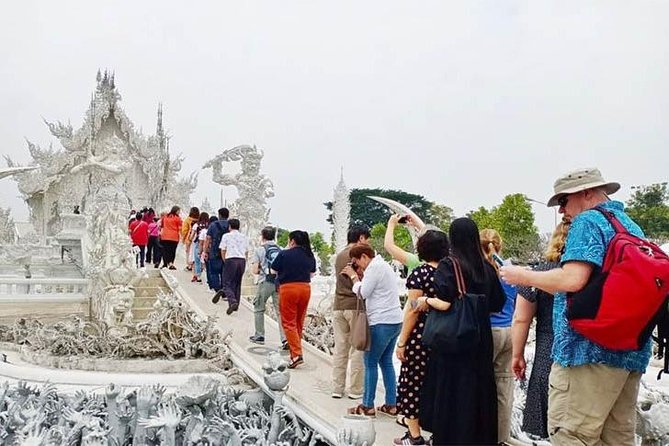
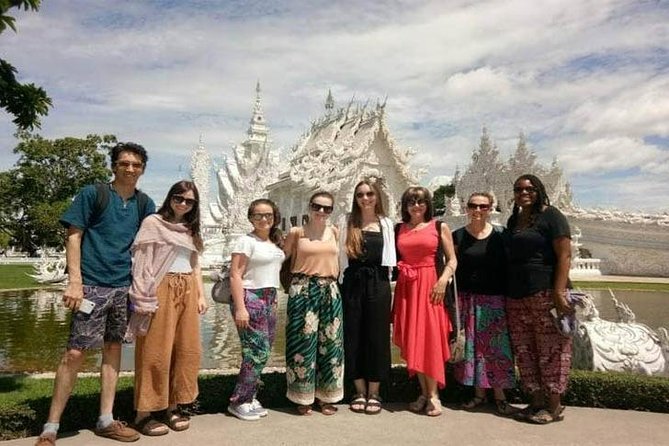
Wat Rong Khun is the headline stop for a reason. It’s built entirely in radiant white plaster, with sparking reflections from mirrored glass mosaics embedded throughout the temple surfaces. Even if you’ve seen photos, the effect in person is a bit surreal: the white isn’t just paint; it’s designed to catch and throw light.
This temple was the idea of Mr. Chalermchai Kositpipat, one of Thailand’s best-known artists. The symbolism is part of the point: a temple all in white meant to signal purity connected to Lord Buddha. What I like about this stop is that it’s both a spiritual setting and a contemporary art project. You’re looking at religious architecture, but it’s clearly made by a modern visual mind.
Inside the mix is also a great standing Buddha in white in front of the back area. The design choices create strong visual framing, so you’ll usually want to take a step back and let your eyes adjust. The temple isn’t just pretty; it’s meant to pull you into details as you move.
Practical tip for your visit: plan for some walking around courtyards and photo angles. The tour time is about 1 hour, so you’ll have enough time to enjoy it without needing to rush, but you still should keep moving.
Baan Dam Museum (Black House): Surreal northern Thai design
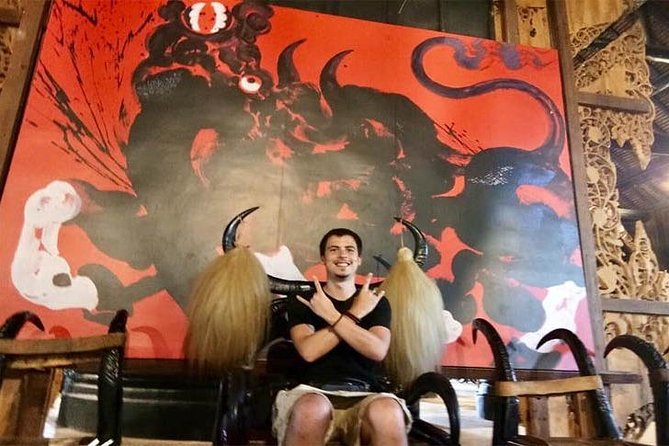
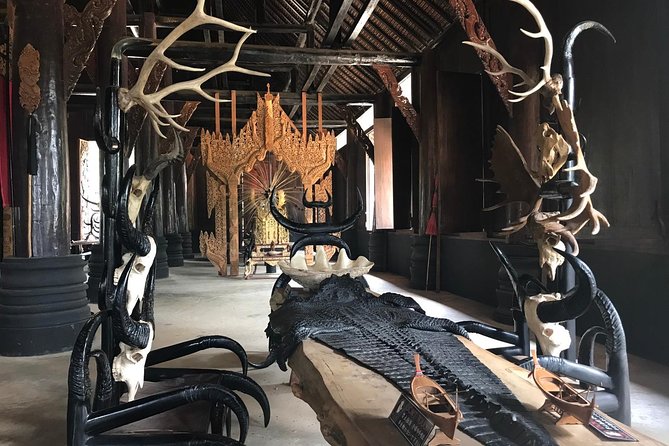
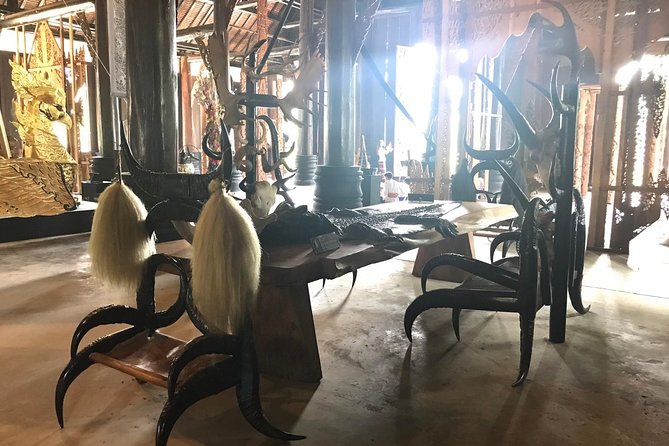
After the White Temple, Baan Dam Museum offers a big mood shift. This is the “Black House,” created by national artist Thawan Duchanee. You can think of it as part art studio, part museum, part home.
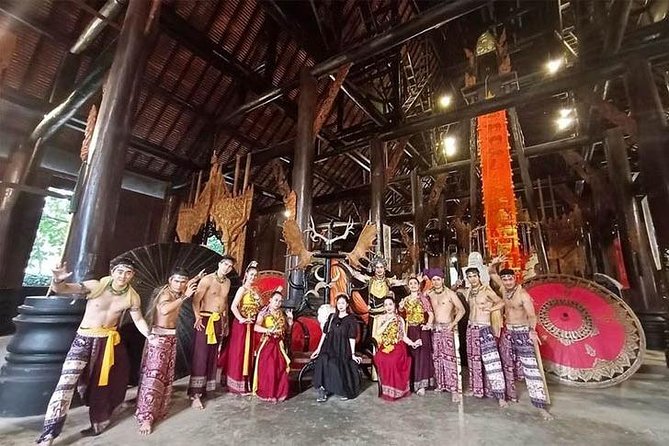
The key detail is the mix: traditional northern Thai buildings appear alongside outlandish modern designs. It’s an eclectic blend, and the themes on display won’t match every visitor’s taste. Still, if you like art that makes you uneasy or forces you to think instead of soothing you, this is a meaningful stop.
The museum is often described as combining sanuk, surreal, and sombre. That sounds like an artsy slogan, but you’ll feel it as you walk around: playful forms can sit next to darker ideas. I like that because it gives your day trip more than one emotional temperature. Chiang Rai’s temple scene is already visually bold, and Baan Dam adds a conceptual twist.
You get about 40 minutes here, with admission included. That’s enough time to wander, look closely, and decide what resonates with you—without turning it into a long museum day.
Wat Rong Seur Ten (Blue Temple): Still under construction, full of color
Wat Rong Seur Ten is outside Chiang Rai in Rong Suea Ten, in the Rimkok district, just a few kilometers away. This is a recent temple, and the tour’s built-in detail is honest: it’s still under construction, even if the main hall is completed.
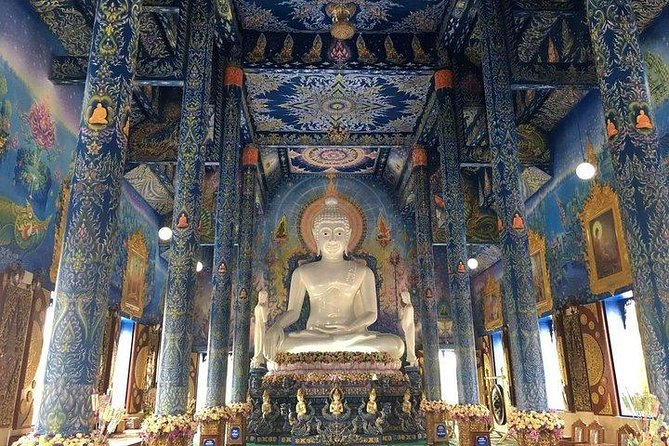
The most memorable feature is the blue interior. It’s not just a blue paint job; it’s designed as a strong backdrop for the spiritual elements. A large white Buddha marks the spirits, and the contrast between blue and white is striking in a way that feels intentional.
The painting style also links back to the White Temple. You’ll notice reminiscent design patterns, which makes this stop extra satisfying if you’ve just been at Wat Rong Khun. It’s like seeing another chapter of the same artistic language, but with a different color identity.
This stop is timed at about 40 minutes. It’s enough for photos, a slow look at interior details, and a chance to notice how the construction state changes what you see.


Mae Khachan Hot Spring: A short free break
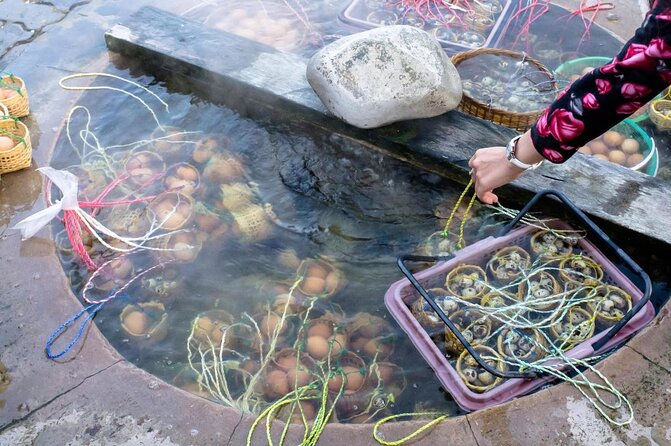
Between temple intensity, you get a 20-minute stop at Mae Khachan Hot Spring. The stop is described as Mae Khachan fountain, and admission here is free.
I like these small breaks on long day trips. You don’t have time to linger like you would at a full hot-spring day, but you do get a reset point before the ride back to Chiang Mai.
Because the tour doesn’t position this as the main attraction, keep expectations realistic. Think of it as a quick pause rather than a full spa experience.
Chiang Rai Drive Time: Why some of the day is just getting around
The tour includes a chunk of time described as driving on the road round trip for about 4 hours. That sounds like a lot if you imagine you’ll spend every minute inside temples, but it’s practical: Chiang Rai sits farther from Chiang Mai, and your sites are spread out.
In other words, don’t treat this as wasted time. Use it to plan your photos, refill water, and mentally group what you just saw: White Temple’s mirror-glass meaning, Black House’s mixed symbolism, and the Blue Temple’s color-first approach.
If you’re someone who likes to narrate your day in your head, this driving time is when you’ll connect the dots.
Optional Add-On Stops: Lalita Café and the Karen Long Neck village
This tour can include add-ons depending on what program you book. Two of the named options are Lalita Café and Longneck Karen Village.
Lalita Café program (if selected)
If you choose the Lalita Café option, you’ll get a 1-hour stop and admission is included for that program. The location is described as a new Himmapan Forest setting in Chiang Rai province, and you’ll get a 60 THB soft drink coupon as part of the program.
This sounds like a scenic break more than a cultural site. I’d treat it like a chance to sit down, cool off, and enjoy a different kind of Chiang Rai experience between temples.
Longneck Karen Village (if selected)
The Longneck Karen Village stop comes with an important caution built into the tour description: information online is conflicting about the ethics of visiting, and many people avoid it over concerns related to exploitation or the idea that villages may be created for tourism.
I’m glad this is flagged, because it means you can make your own call with open eyes. If this topic matters to you, read carefully before selecting the add-on and decide based on your comfort level.
The visit time is about 1 hour, and admission is included for the program. Just remember: it’s an ethical question as much as a sightseeing one.
Comfort and attention: Small-group effects that matter
This is listed as a maximum of 12 travelers, and that’s not just marketing. On a day with multiple paid stops and short time windows, a small group changes how it feels.
You’re less likely to get lost in the shuffle. You can also ask a question and get an answer before the group moves on. And because there’s an English tour guide, you’re usually not stuck staring at signage you can’t read.
One review highlights a guide named Mm and notes her approachable explanation style, including a nickname built to help people remember. Another review points out a situation where the guide’s English wasn’t strong and the lunch didn’t land for them. That mix is a reminder: language quality can affect how much you get from temple visits.
So if you want detailed explanations, pay attention when booking and consider your comfort level with partial English.
What to expect at lunch and entry tickets
Lunch is included, and entry tickets for the core temple stops are included in the program. This is one of the best parts of booking a packaged day trip: you avoid the slow hunt for ticket lines and food budgeting while you’re already tired.
That said, lunch can be a wildcard in any tour. One review said the lunch didn’t feel worth it, while the rest of the day was still praised for organization and sights. My advice: go in hungry, but don’t judge the whole day if lunch isn’t a standout.
Should you book? A quick fit check
Book this tour if you want:
- A structured one-day way to see Wat Rong Khun, Baan Dam, and Wat Rong Seur Ten.
- A small-group experience with an English-speaking guide and an included lunch.
- A day focused on big visuals and strong design ideas, not a slow museum crawl.
Skip or reconsider if you:
- Hate rushed schedules and need lots of free time between stops.
- Rely on detailed English explanations and know you’ll be frustrated if the guide’s English isn’t strong.
- Feel uneasy about the ethical questions around the Karen Long Neck village add-on.
If your goal is maximum Chiang Rai per hour, this is built for you.
FAQ
How long is the Chiang Mai to Chiang Rai day trip?
It runs for about 11 hours.
What are the main sights included?
The core stops are Wat Rong Khun (White Temple), Baan Dam Museum (Black House), and Wat Rong Seur Ten (Blue Temple). There is also Mae Khachan Hot Spring and driving time around Chiang Rai.
Is lunch included?
Yes. Lunch is included in the tour.
Does the tour include entrance fees?
Yes for the included stops. Admission fees depend on which additional program you book (like Lalita Café or Karen Village).
What time does the tour start?
It starts at 7:00am.
Is pickup offered?
Yes. The tour starts at McDonald’s at 17/1 Kotchasarn Rd in Chiang Mai, and it ends back at the meeting point.
How large is the group?
The tour has a maximum of 12 travelers.
Do I need good weather?
Yes. The experience requires good weather, and if it’s canceled due to poor weather you’ll be offered a different date or a full refund.
Final call: My take on booking this day trip
I’d book it if you’re short on time and you want a clear, high-impact route through Chiang Rai’s most visually dramatic temple stops. The included lunch and tickets, plus the small-group size, make it easier to enjoy the day without logistics headaches.
Just go in knowing it’s long, and be thoughtful if you’re adding the Longneck Karen Village option. If you pick the right add-ons for your comfort level, this one-day mix of white, black, and blue art is exactly the kind of Thailand experience that sticks.