REVIEW · CHIANG MAI
Private Chiang Mai City Tour including Wat Doi Suthep, Wat Suan Dok (SHA Plus)
Book on Viator →Operated by Sightseeingbangkok.com · Bookable on Viator
Six temples in one smooth day. This private Chiang Mai city tour is a great way to see the big names—Wat Phra That Doi Suthep and more—without worrying about transit, tickets, or where to stand for the best views.
I especially like that you get round-trip hotel transportation and an English-speaking guide. It makes the whole day feel practical, not like a scavenger hunt with a timetable.
One thing to keep in mind: you’ll cover a lot in about 8 hours, with short temple stops. And Doi Suthep is famous for its steps, so if stairs are an issue, plan accordingly.
In This Review
- Key highlights worth knowing
- A private day plan that keeps Chiang Mai from turning into logistics
- Wat Phra That Doi Suthep: the 306 steps and the hilltop reward
- Wat Ched Yot (Wat Jed Yod): the 15th-century royal temple with mixed styles
- Wat Suan Dok: white chedis, a former flower garden, and a Sri Lankan-style golden stupa
- Wat Phra Singh: the Lion Buddha monastery with monks living there
- Wat Chedi Luang Varavihara: the massive chedi and the earthquake scar
- Wat Chiang Man: Chiang Mai’s oldest temple from 1296
- Timing, walking, and what to wear for an 8-hour temple loop
- Price and value: is $107.55 a fair deal?
- Who should book this tour (and who should skip)
- Should you book? My take
- FAQ
- What temples are included on this Chiang Mai tour?
- How long is the tour?
- Does the tour include hotel pickup and drop-off?
- Are admission fees included?
- Is lunch included?
- Is there a guide, and is it in English?
- What does SHA Plus mean here?
Key highlights worth knowing
- Wat Doi Suthep’s 306 steps and myth-made balustrades (Nagas) set the tone fast
- English-speaking explanations that connect carvings, murals, and religious meaning to what you’re seeing
- Admission fees included so you don’t do last-minute math at the ticket desk
- Lunch and refreshment breaks built into the schedule, plus cold towels and bottled water during the day
- Six major temple stops in one loop saves time inside and around the old city
- SHA Plus certified operator, with Covid-era health protocols noted and a vaccinated workforce requirement
A private day plan that keeps Chiang Mai from turning into logistics
What you’re really buying here is time and peace of mind. With hotel pickup and round-trip transfer, you can focus on temples instead of buses, songthaews, and figuring out parking. It’s also a private tour, so you’re not stuck waiting for a large group to shuffle into the next photo spot.
The day runs about 8 hours, and the schedule is built around a calm rhythm: each main stop gets around 30 minutes. That’s enough time to look closely, take photos, and listen to your guide’s context without feeling rushed through the front gate and out the back door.
You’ll also get a steady flow of included extras. Admission fees are part of the price, and lunch is included. On hot days (Chiang Mai loves to bring heat), that matters more than it sounds.
You can also read our reviews of more city tours in Chiang Mai
Wat Phra That Doi Suthep: the 306 steps and the hilltop reward
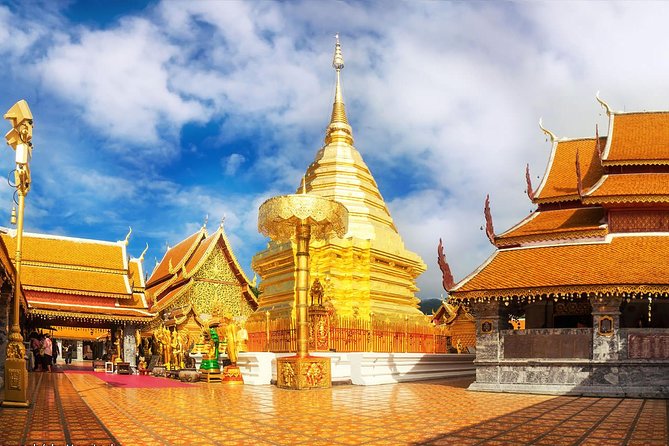
Doi Suthep is the temple most people use as their Chiang Mai “start here” moment, and for good reason. You’ll head up to Wat Phra That Doi Suthep, which sits on the hill and is reached by 306 steps. Along the way, you’ll see the mythical Naga balustrades—serpent-like figures that frame the climb and keep the vibe from feeling like just stairs.
Inside, the temple is known for housing a holy relic of Buddha. That’s not trivia for trivia’s sake. It helps explain why people come dressed for reverence and why the temple feels more like a living spiritual site than a museum stop.
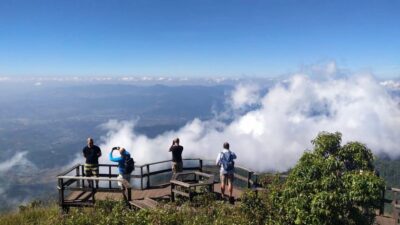
And then there’s the payoff: the grounds offer panoramic views of the city, especially when the day is clear. If the sky is hazy, you’ll still get a satisfying sense of elevation, but the dramatic lookouts depend on weather.
Practical tip: wear shoes you trust. The steps at Doi Suthep are part of the experience—so treat them like part of your workout plan.
Wat Ched Yot (Wat Jed Yod): the 15th-century royal temple with mixed styles
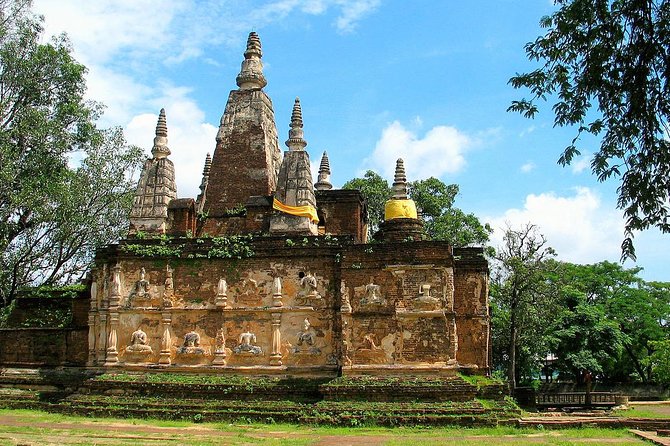
Next you head to Wat Ched Yot (also known as Wat Chet Yod and Wat Photharam Maha Vihara). This is a Lanna-area temple complex on the outskirts of Chiang Mai, and it’s a good contrast to the big-city landmarks.
One reason this stop works: the architecture reflects a blend of influences—Lanna, Rattanakosin, Lao, Chinese, and Indian. Your guide can point out how those influences show up in details, not just big shapes. It’s also a Royal temple dating back to the 15th century, built during the reign of King Tilokkarat (1441 to 1487).
The temple is also tied to royal memory. You’ll learn that the king’s ashes are enshrined in a chedi on the grounds. That detail changes how you look at the chedi shapes and why certain areas feel intentionally preserved.
Time is shorter here, so I’d focus on the main structures and take in at least one set of carvings closely. The mixed-style architecture rewards slow attention.
Wat Suan Dok: white chedis, a former flower garden, and a Sri Lankan-style golden stupa
Wat Suan Dok sits just west of the walled old part of Chiang Mai, and it’s famous for one thing in a very physical way: lots of chedis, especially white ones. The name is tied to an old royal setting—flower garden temple—because the area was once used as royal flower gardens.
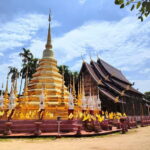
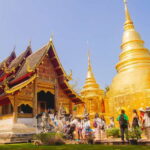
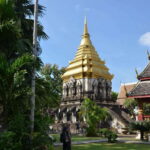
One of the most striking features is the large golden chedi, described as Sri Lankan style. It’s listed as 48 meters high and said to contain a Buddha relic. Then around it are many smaller white chedis holding ashes of members from several generations of the Chiang Mai Royal Family.
If you like temples where you can wander without feeling like you’re fighting crowds for angles, this stop is often a favorite. It also tends to feel more spacious than the most famous inner-city sites.
Weather tip: this one can be bright. Bring sunglasses and keep water handy, especially if your day starts early and you’re climbing steps later.
Wat Phra Singh: the Lion Buddha monastery with monks living there
Back in the old city area, you’ll visit Wat Phra Singh, a major temple that’s both historic and active. It’s often described as the Monastery of the Lion Buddha (also translated as the temple of the Lion Buddha), and it matters because it’s not just a landmark—it’s a working temple.
This is an active site with hundreds of monks and novices living there. That simple fact changes the whole experience. You’ll likely notice the everyday rhythm of caretakers, worshippers, and monks, which gives the temple a real “here and now” feeling.
Wat Phra Singh is also associated with highly old Buddha images, so your guide can help you understand why visitors come, pause, and look where they do. Even with a short visit, the atmosphere helps you connect the architecture to present-day religious practice.
Practical consideration: since it’s active, follow the cues around respectful dress and behavior. Your guide will usually set the tone quickly.
You can also read our reviews of more private tours in Chiang Mai




Wat Chedi Luang Varavihara: the massive chedi and the earthquake scar
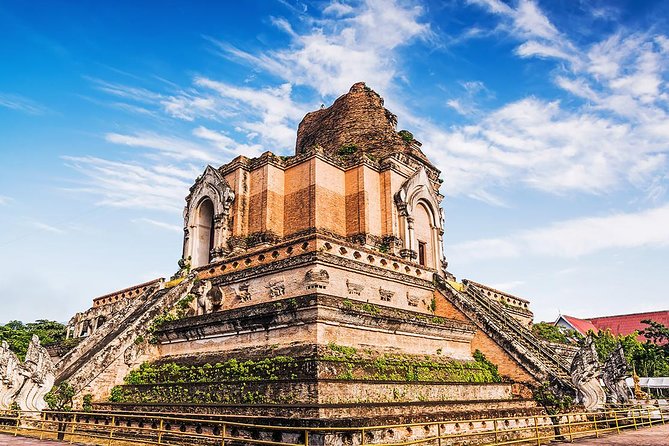
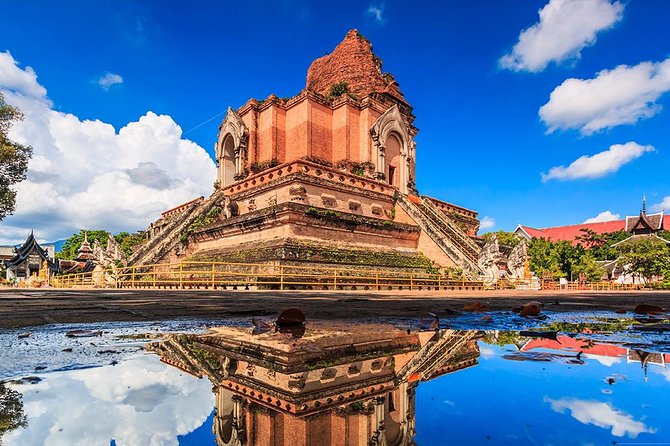
Wat Chedi Luang Varavihara is all about scale. The centerpiece is a massive chedi (pagoda) that dominates the area and anchors the story of the site.
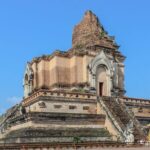
Here’s the timeline your guide can walk you through: the chedi was ordered to enshrine the ashes of a father by King Sean Muang Ma. Construction began in 1391 and lasted almost a century. It was completed in 1475 during the reign of King Tilokkarat, reaching about 85 meters high and roughly 44 meters wide, making it the largest structure in Chiang Mai at the time.
Then came the disaster. In 1545, a massive earthquake destroyed much of the top, taking off about 60 meters. About 60 meters remained, and later in the 1990s, the chedi was partially restored.
That sequence—ambition, destruction, repair—makes the temple feel honest. It isn’t frozen in time. It shows how history physically shapes what you see today.
If you want photos, stand back first to capture the full chedi shape, then move closer for details. The story lives at both distances.
Wat Chiang Man: Chiang Mai’s oldest temple from 1296
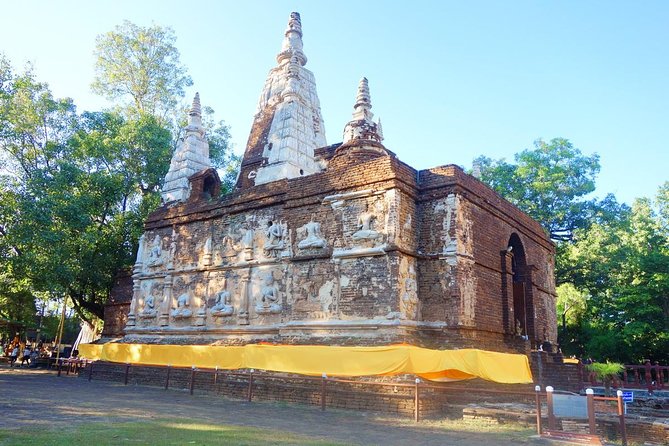
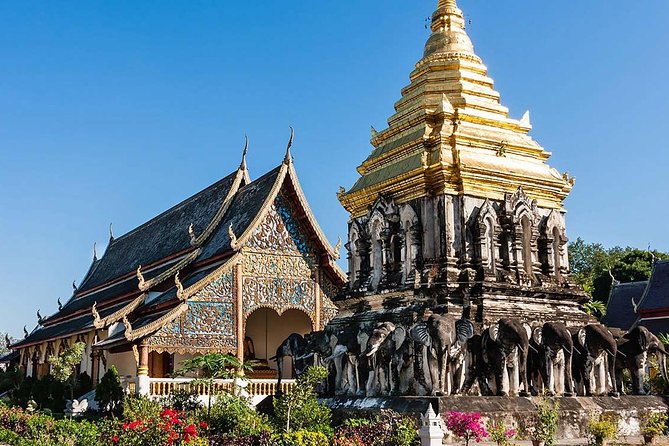
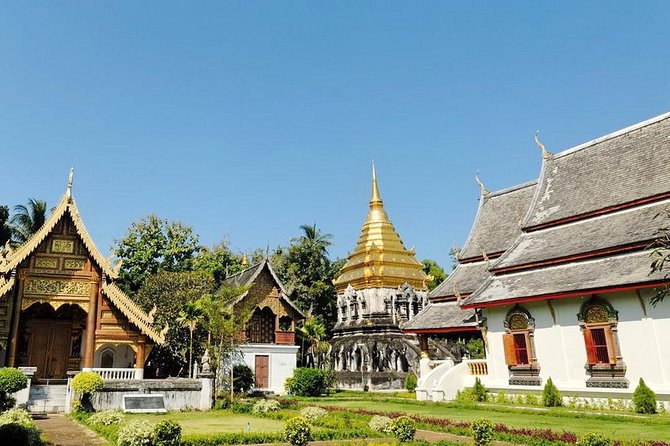
To finish the circuit, you’ll stop at Wat Chiang Man, described as the oldest temple in Chiang Mai, going back to 1296. This one connects directly to the city’s origin story.
The temple is linked with King Mengrai, who decided to build a new city and make it the Lanna Kingdom’s new capital. Wat Chiang Man was built as the first temple of the new city on the site used to supervise construction.
The temple holds several very old and important Buddha images, which makes it a strong final stop. By this point, your guide’s explanations have probably helped you “read” temple spaces better—where people look, what structures mean, and why certain areas are emphasized.
If you’re feeling temple-fatigued by hour five or six (normal), this is a good place to slow down. The age and origin angle make it stick.
Timing, walking, and what to wear for an 8-hour temple loop
This is a full day with a lot of movement, even though each stop is around 30 minutes. The schedule runs through late afternoon and includes a return around 4:30 to 5:00 pm.
Plan for three physical realities:
- Stairs at Doi Suthep (306 of them) are part of the experience
- You’ll likely walk on uneven temple grounds
- Chiang Mai can feel hot and bright, so you’ll want water and breaks
One small but real comfort detail: the tour includes cold towels and a steady supply of cold water bottles. That’s not just nice service. It keeps you from turning the last half of the day into a survival test.
Dress like you’re visiting a spiritual site: shoulders and knees covered. Bring a light layer for shade and wear shoes you can grip.
Price and value: is $107.55 a fair deal?
At $107.55 per person, this tour sits in the “worth it if you hate logistics” zone. Here’s why the value makes sense on paper.
You’re paying for:
- Private, English-speaking guidance
- Round-trip transfers from your hotel
- Admission fees included (so you’re not paying at each temple)
- Lunch included
- A structured day that hits six major temple stops
If you were to piece this together yourself, you’d likely pay separately for transport, guide time, tickets, and lunch. The built-in admissions are especially useful at temples where you’d otherwise pause to calculate what you’re missing.
The tour also shows signs of being designed for comfort and pacing. The included cooling touches—cold towels and plenty of water—are the kind of detail that can make a big difference when you’re hopping between hilltop and city sites.
If you’re traveling with friends, you can ask about group discounts. Since it’s private for your group, it can make sense for a small party rather than solo.
Who should book this tour (and who should skip)
This is a good fit if you want a tight, efficient day that still includes meaningful context. It works well for first-time Chiang Mai visitors, couples, and anyone who likes temples but doesn’t want to spend half the day figuring out transport.
It’s also a good choice if you’re the type who enjoys learning what you’re looking at—murals, carvings, and Buddhist meaning—because the guide’s explanations are built into each stop.
I’d think twice if:
- Stairs are a major issue, because Doi Suthep’s climb is part of the deal
- You hate short visits and want long, slow temple time (this schedule is more “see the key sites” than “linger for hours”)
The sweet spot is people who want a well-managed day and don’t want to lose time.
Should you book? My take
If your goal is to see the core temple highlights around Chiang Mai in one day, this tour makes that easy. The combination of hotel pickup, admission included, and a guide who explains what you’re seeing is the real win.
Book it if you want structure, comfort, and clear value at a predictable price. Skip it only if you know you’ll struggle with stair-heavy sightseeing or you want a slower, less scheduled day.
FAQ
What temples are included on this Chiang Mai tour?
You’ll visit Wat Phra That Doi Suthep, Wat Ched Yot (Wat Jed Yod), Wat Suan Dok, Wat Phra Singh, Wat Chedi Luang Varavihara, and Wat Chiang Man.
How long is the tour?
The tour duration is listed as about 8 hours.
Does the tour include hotel pickup and drop-off?
Yes. Round-trip transfer is included, and you’ll be picked up from your hotel and returned back to the meeting point.
Are admission fees included?
Yes. Admission fees are included in the tour price.
Is lunch included?
Yes. Lunch is included.
Is there a guide, and is it in English?
Yes. The tour includes an English-speaking guide.
What does SHA Plus mean here?
The experience is listed as SHA Plus certified, meaning the operator has approved Covid-19 health and preventative protocols in place and 70% or more of employees are fully vaccinated.
If you want, tell me your travel dates and whether you’re okay with stairs, and I’ll suggest how to plan your day around Doi Suthep (timing, outfit, and what to prioritize).